Intelligent Design of Information and Energy Systems
Research / Communication Networks

Smart
Networks

RESILIENT & INTELLIGENT COMMUNICATION

Keep connections alive.
Make networks smarter.

IoT blockchains that work without base stations, multipath communication that uses several paths at once, and Wi-Fi that adapts intelligently to the situation. We build and test the networks of the future, where 5G, Wi-Fi and IoT coexist.

IoT BlockchainMultipath / 5GIntelligent Wi-Fi
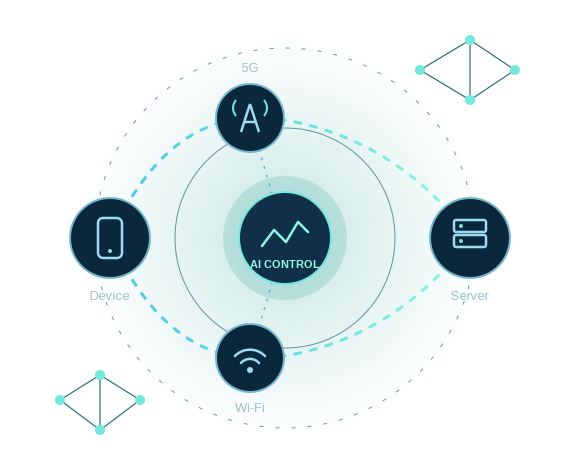
A device connects to a server over two paths, 5G and Wi-Fi, with AI controlling the paths
Overview of our network research (schematic)

Our network research.

Toward networks that are not only fast, but also never stop and adapt to the situation.

From networks that follow fixed rules to networks that decide for themselves.

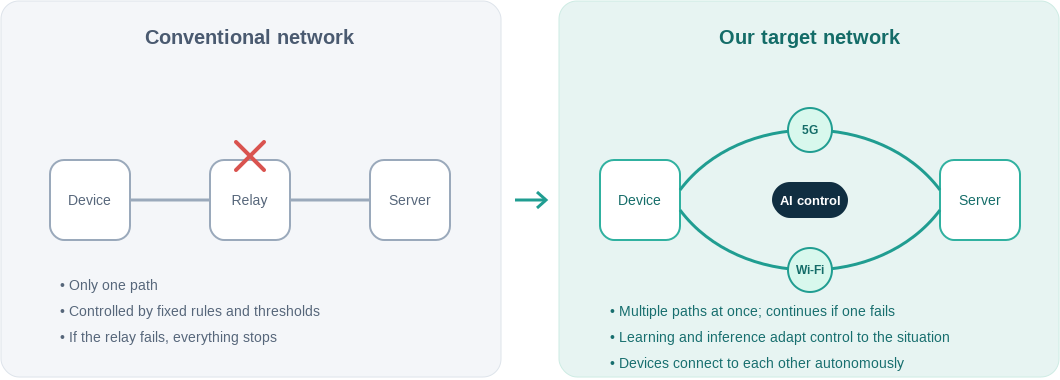
Communication has traditionally used a single path controlled by predefined rules and thresholds. But in today's environment — where 5G, Wi-Fi and IoT coexist, devices move, and each application needs a different quality of service — fixed rules alone are not enough.

We combine simultaneous use of multiple paths, learning-based network control and autonomous distributed networks that do not depend on base stations, and evaluate their performance on real hardware and emulators.

IoT blockchainMultipath communicationWi-FiMachine learning / LLM
From a single path and fixed rules to multiple paths and learning-based controlComparison of network design approaches
Left: a conventional single-path network that stops if the relay fails. Right: our network with two paths (5G and Wi-Fi) controlled by AI
* Illustrative schematic.

Three lines of research for smart, resilient networks.

IoT blockchains independent of base stations, multipath communication using several paths at once, and Wi-Fi that adapts intelligently. Every theme is evaluated by actually running it on hardware or emulators.

RESEARCH THEME 01 · IoT BLOCKCHAIN

Resilient
IoT blockchain

IoT-Blockchain over Mobile Ad-hoc Networks

Combining IoT with blockchain enables tamper-proof, reliable data and small payments between IoT devices. But when communication goes through a base station or access point, as with Wi-Fi or LTE, the whole system stops if that one device fails (a single point of failure).

We build blockchains on mobile ad-hoc networks (MANETs), where devices connect directly to one another, aiming for IoT blockchains that keep running even when failures occur or devices move around.

  • Building blockchains on ad-hoc networks
  • Automatic recovery from failures and communication reliability
  • Performance evaluation in mobile environments
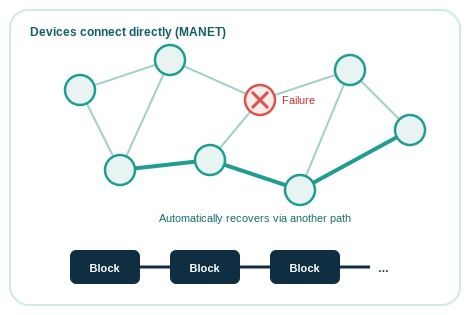
In a network of directly connected devices, communication recovers via another path when one fails, and the blockchain keeps running
Blockchain on an ad-hoc network (schematic)
RESEARCH THEME 02 · MULTIPATH

Using multiple paths at once:
Multipath communication

Multipath TCP (MPTCP) and 5G Multi-Connectivity

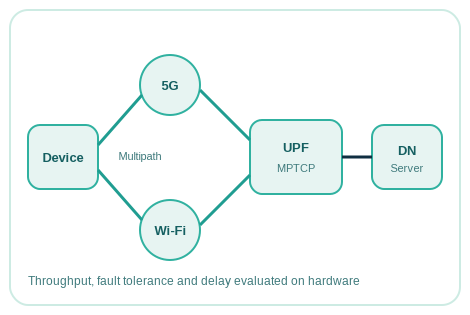
Smartphones and IoT devices have multiple interfaces such as 5G and Wi-Fi, but ordinary TCP can use only one path. Multipath TCP (MPTCP) uses several paths simultaneously, improving throughput and providing fault tolerance so that communication continues even if a path fails.

We combine MPTCP with new technologies such as 5G, IoT routers and SDN, build real networks and evaluate their performance.

  • Multi-connectivity combining 5G and Wi-Fi
  • Bringing multipath communication to IoT routers
  • Network-side multipath communication with SDN and P4
A device connects to the UPF over 5G and Wi-Fi, and MPTCP delivers data to the server
Multipath communication over 5G and Wi-Fi (schematic)
RESEARCH THEME 03 · Wi-Fi / WIRELESS

Intelligent, adaptive
Wi-Fi and wireless networks

Intelligent Wi-Fi and Wireless Network Control

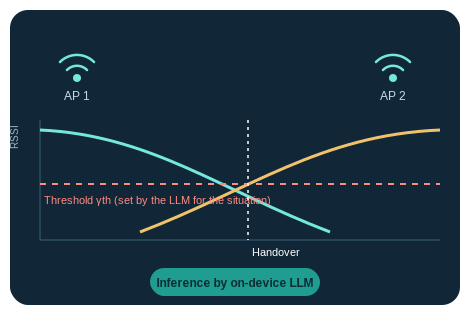
Wi-Fi is everywhere, but it is often controlled by fixed rules and thresholds, so it does not always cope well with user movement, congestion or different applications. For example, switching access points at a fixed threshold can cause repeated switching or leave a device stuck on a weak signal.

We use machine learning and large language models (LLMs) to control wireless networks according to the situation, with an emphasis on running them on resource-limited devices such as Raspberry Pi or the user's own device.

  • Wireless network control with machine learning and LLMs
  • Optimizing access point switching (handover)
  • Implementation on resource-limited edge devices
Signal strength of two access points and the switching threshold decided by an LLM
Signal strength and handover threshold (schematic, not measured data)

From networks that only connect
to networks that think and act.

Not just speed, but also resilience, adaptation to each application, and the ability to run on everyday devices. We verify, through implementation and evaluation, the properties needed for networks that underpin society.

Communication that never stops

Using multiple paths at once and letting devices connect autonomously keeps communication going even when something fails.

Control tailored to each use

Machine learning and LLMs identify the type of traffic and the situation, and control the network to meet requirements such as delay, loss and bandwidth.

Runs on everyday devices

We run and evaluate our methods on resource-limited edge devices, such as Raspberry Pi and on-device LLMs.

* Figures on this page are illustrative schematics. For our results, see the Publications page.